
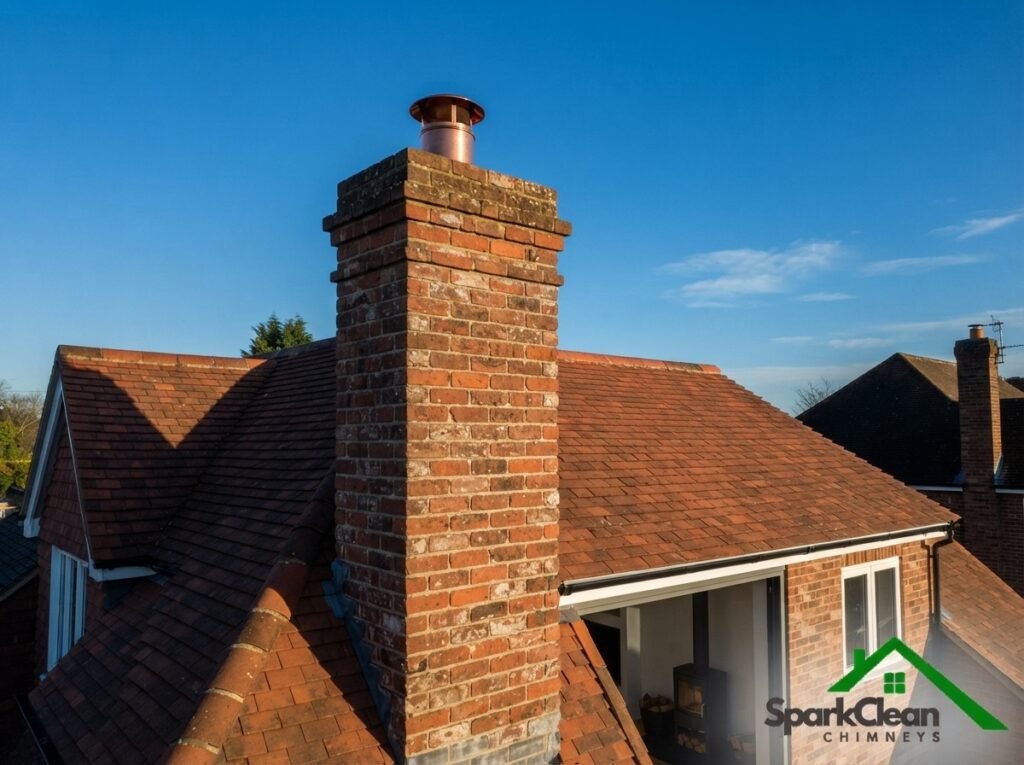
A chimney fire is one of the most frightening events a homeowner can experience. Often described as sounding like a low freight train or a loud roaring jet engine, a flue fire occurs when heavy creosote deposits ignite inside the chimney shaft. Temperatures during an active flue fire can rapidly exceed 2,000 degrees Fahrenheit, subjecting internal masonry, metal liners, and structural framing to violent thermal shock.
Even if a chimney fire appears to put itself out, lighting another fire without a thorough diagnostic evaluation is extremely dangerous.
Similarly, severe midwestern weather events—such as windstorms, heavy freeze-thaw cycles, or lightning strikes—can compromise the structural stability of your stack. Scheduling an immediate, high-definition chimney inspection following any thermal or environmental event is the only way to verify whether your system is safe for continued use.
The Invisible Aftermath of a Flue Fire
When high heat bakes a chimney stack, the damage is rarely confined to the firebox. Thermal shock causes distinct, highly dangerous structural transformations along the entire length of your exhaust system:
-
Shattered Clay Flue Tiles: Ceramic flue liners are designed to withstand normal combustion temperatures, but sudden heat spikes cause tiles to crack, split, or explode. Cracked tiles allow future heat, sparks, and toxic gases to reach interior house framing.
-
Melted or Warped Stainless Steel Liners: Intense flue fires can melt, warp, or breach metal liner connections, destroying structural continuity and breaking outer insulation barriers.
-
Melted Mortar Joint Compounds: Extreme heat turns lime-based mortar joints into brittle powder, leaving open gaps between ceramic tiles where flames can penetrate.
-
Combustion Heat Transfer to Wood Framing: Extreme heat can char or weaken surrounding attic joists and wall studs without showing immediate external fire damage.
Weather-Related Structural Hazards in Northern Illinois
Thermal shocks are not the only threat to your chimney infrastructure. Severe local weather conditions frequently inflict subtle structural damage that demands professional evaluation:
-
Lightning Strikes: A direct lightning strike can instantly shatter concrete chimney crowns, blow apart brick masonry stacks, and crack interior clay flue liners.
-
Freeze-Thaw Masonry Spalling: Moisture trapped inside brick pores freezes and expands during harsh winter shifts, popping the faces off bricks and destroying the structural balance of the stack.
-
High-Wind Separation: Powerful windstorms can dislodge top spark arrestor caps, bend flashing seals away from the roofline, or loosen upper masonry courses.
What a Post-Event Level 2 Inspection Entails
Following a flue fire, lightning strike, or severe weather event, standard visual checks are legally and structurally insufficient. A comprehensive Level 2 diagnostic evaluation utilizes specialized equipment to assess total system integrity:
-
Roof-Level Masonry & Crown Assessment: Technicians inspect upper masonry courses, counter-flashing, concrete crowns, and caps for structural displacement or severe cracking.
-
360-Degree Internal HD Video Scan: A specialized rotating dual-view camera is navigated vertically through the entire flue shaft. Every individual tile, liner seam, and smoke chamber wall is recorded in high definition to document thermal stress fractures.
-
Attic and Framing Clearance Check: Technicians evaluate accessible points where the masonry passes through ceiling joists and roof structures, checking for scorched insulation or charred wood framing.
-
Insurance Documentation & Reporting: You receive a detailed diagnostic report complete with video footage and still photos, providing clear structural proof required for home insurance claims.
Why You Must Never Relight a Fire Before Inspection
Lighting a fire in a chimney that has suffered thermal shock or storm damage creates an immediate house fire hazard. Sparks traveling up a cracked flue can easily enter wall cavities, igniting dry wood framing behind your drywall.
Furthermore, cracked liners permit invisible, odorless carbon monoxide gas to drift into bedrooms and upper-floor living spaces. A professional diagnostic check gives you total clarity and ensures necessary structural repairs are made before your hearth is used again.
Local Service Area: Lake County, IL
SparkClean Chimneys provides emergency post-fire evaluations, diagnostic video chimney inspections, insurance documentation reports, and structural restoration services across the region:
-
Primary Location: 333 IL-83, Mundelein, IL 60060
-
Service Communities: Mundelein, Libertyville, Vernon Hills, Hawthorn Woods, Long Grove, Lake Zurich, Buffalo Grove, Lincolnshire, Wauconda, Deerfield, and Round Lake.
Experienced a Flue Fire or Storm Damage in Lake County?
Don’t take risks with hidden structural damage or family safety. Schedule a certified high-definition video inspection with our expert team to confirm your hearth is completely secure.
📍 Visit Our Location:
Google Maps – SparkClean Chimneys
333 IL-83, Mundelein, IL 60060, United States
📞 Call Our Local Experts Today:
+1 (847) 380-9496
🌐 Schedule Online: